
Your Operators Shouldn’t Have to Be Detectives.
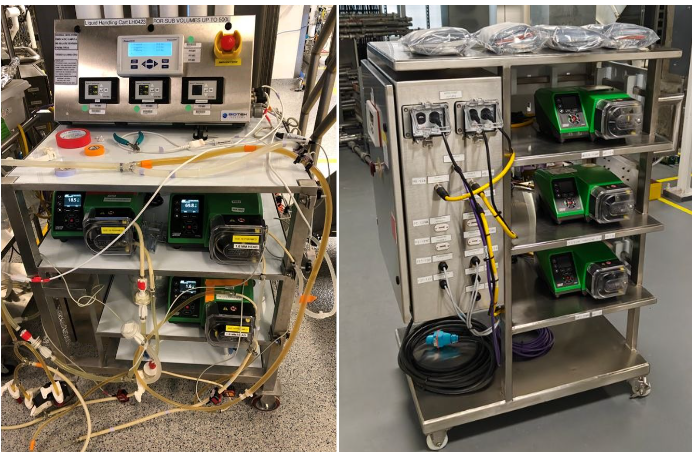
Take a look at the first photo.
If you’ve worked in a GMP manufacturing facility, you can probably picture what happens before the process even starts.
An operator pauses for a moment to answer a few questions:
• Which hose connects where?
• Which pump is feeding which line?
• Which cable belongs to which instrument?
• Is this the correct connection, or was something moved after the last run?
None of those questions should have to be asked.
Every minute spent tracing hoses, following cables, or confirming connections is time that could be spent on the process itself. More importantly, every additional decision creates another opportunity for human error.
The goal of good engineering isn’t simply to make equipment functional.
It’s to make it intuitive.
When equipment has evolved over years of modifications, it often relies on operator experience instead of thoughtful design. The people running the process become the ones compensating for the equipment.
That can lead to:
• Longer setup and changeover times
• Greater dependence on experienced operators
• More opportunities for incorrect connections
• Slower troubleshooting when something doesn’t look right
• Additional training for new personnel
• Inconsistent execution from one shift to the next
**Now compare that to the second photo.**
The difference isn’t just that it’s cleaner.
The equipment has been organized so the process is easier to understand at a glance.
Pumps have defined locations. Tubing follows intentional routing. Cables are organized. Components are accessible. The cart supports the operator instead of forcing the operator to interpret it.
That’s what custom engineering should accomplish.
At Hart, many of the process carts and skids we design aren’t replacing existing equipment – they’re replacing years of incremental changes that gradually made a system more difficult to operate and maintain.
The result is equipment that’s easier to use, easier to maintain, and easier to support throughout its lifecycle.
If your team is relying on experience to navigate process equipment that has become increasingly complex over time, it may be worth taking a fresh look at the design. Often, a well-engineered custom cart can reduce complexity, improve consistency, and make everyday operations smoother for everyone who uses it.